I watched a video about Stephen King testifying in a publishing trial, and suddenly our little business plan made a whole lot more sense. Which is encouraging. I would hate to eat all those cans of beans without a plan. The video raised a fair question: what happens after somebody agrees to publish your book? Does the machinery start turning, the readers arrive, and the author finally get to sit down?
I have spent fourteen years getting Midnight Radio into the world. I am interested in what happens next. Linda and I went looking for the evidence behind the video, because a good story and an accurate explanation ought to be able to share a room.
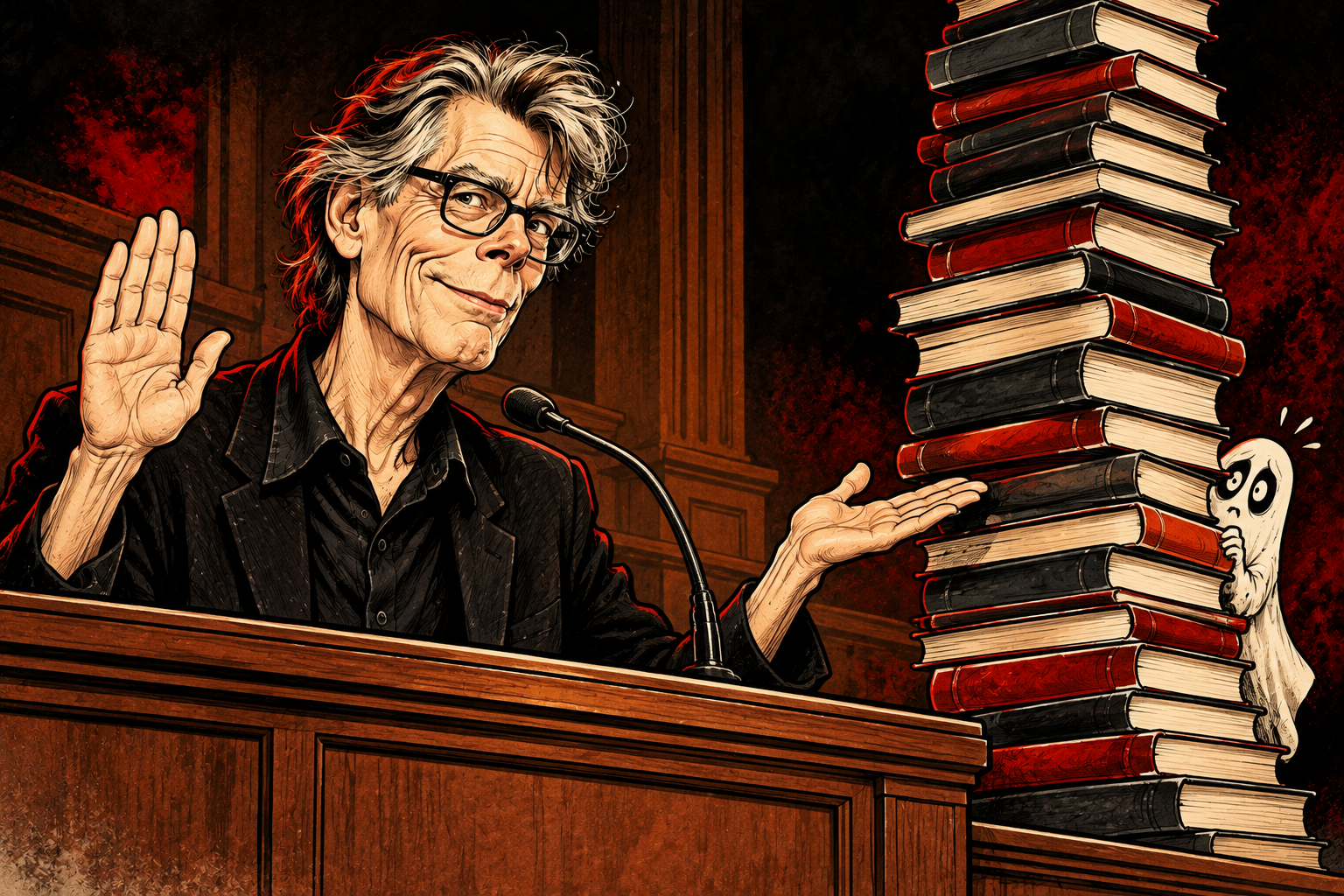
Stephen King wasn’t testifying against books
In August 2022, King testified against Penguin Random House’s proposed acquisition of Simon & Schuster. He opposed further consolidation and its effect on writers. The Justice Department won an injunction blocking the merger that October. This was a competition case, particularly about the purchase of rights to anticipated top-selling books. It was not a trial declaring every publisher bad at its job. 1, 2
The publisher is placing a bet
When a publisher accepts an author’s book, it is committing money and work before it knows how readers will respond. An advance, editing, production, distribution, and promotion all have to be considered. The publisher is betting that enough people will buy the finished book to justify that investment. 3, 4, 7
And these experienced professionals do not reliably pick a profitable book every time. The court’s 2022 opinion cites figures of 35 profitable books out of 100. Under those figures, 65 did not turn a profit. It also records that the top 4 percent of profitable titles generated 60 percent of profitability. 3
That is a serious gamble, even with experience and resources behind it. These are historical figures from the case, not today’s odds for every publisher or a measure of literary quality.
A book can be beautifully written and still fail to cover its costs. A publisher can believe in a manuscript, invest in it, and get the commercial outcome wrong. A few exceptional successes help carry the rest of the list.
That gave me a different way to look at the business. An acceptance is somebody’s informed bet. A rejection is somebody deciding not to place one. Neither is the final word from the people who might love the story.
A publisher can take chances across a large list. An author experiences that list one manuscript at a time.
An advance is money, but it isn’t a crystal ball
An advance is an upfront payment against an author’s future royalties. As those royalties accumulate, they are credited against the advance. Additional royalty payments generally begin after it earns out. The Authors Guild explains that an author ordinarily does not repay an unearned advance in cash merely because sales disappoint; contractual breaches are a different matter. 4
The court also recorded that more than 85 percent of contracts for anticipated top-selling books did not earn out. Crucially, it explains that a publisher can profit before the author’s advance fully earns out. 3
So an unearned advance is not automatically a publisher’s loss, a bad book, or a verdict on whether somebody’s story deserved to exist.
It means we need to know which number we are talking about before we start throwing the furniture.
Follow the money, all of it
The video gives an example of an author earning $1.35 from an $18 paperback. At a 7.5 percent royalty on retail price, that arithmetic is right. The Authors Guild identifies 7.5 percent as a common trade paperback royalty, although contracts and sales terms vary. 5
But the rest of that $18 does not all become the publisher’s profit. Bookselling, distribution, printing, and publishing have costs. As an independent publisher using IngramSpark, I encounter that arithmetic too: its wholesale compensation formula deducts the wholesale discount and printing cost from list price, with applicable fees and adjustments also needing attention. 6
Owning the publishing business gives me more decisions. It also gives me more bills.
The printer has yet to accept artistic fulfillment as payment.
A publishing contract doesn’t make discovery automatic
Big publishers bring real resources. Jane Friedman distinguishes having a book available to order from having a sales team persuade stores to stock it. Those are different achievements. 7
I am happy to see Midnight Radio available through Barnes & Noble and Books-A-Million online. That does not mean it is sitting on the shelf in every store. It means a reader has another way to get it.
How much promotion comes with the deal?
The video puts one rough marketing average at about $3,000 per book. I could not verify that as a typical budget for a novel, and an average would not tell us what any particular author receives.
The court offers a firmer comparison: PRH and Simon & Schuster averaged under $10,000 in marketing for books with advances below $250,000, versus $40,000–$90,000 above that level. 3
That spending does not capture every benefit of their sales teams, distribution, or publicity relationships. But it does show that being published and receiving a major promotional campaign are different things. 8
Then there is the time window. In a 2017 interview, publishing commentator Jane Friedman described a common pattern: after about three months, attention often falls away unless a book gains traction and gives the publisher a reason to invest again. It is an observation about the business, not a rule in every contract. 7
You can spend years writing a book and have a much shorter window in which to establish its audience.
That is why I want a plan that keeps taking the story to new readers, town after town. Our tour gives us another place to begin each time we arrive.
If the book is good, why do I need them?

“I am the literary equivalent of a Big Mac and fries.”
Stephen King
Quotation source ↗
That is the question I keep coming back to.
A publisher can provide money, skilled people, established relationships, and access that would be difficult to build alone. For an author, those can be excellent reasons to sign a good publishing deal. 4, 7
But do I need a major publisher’s permission to put a good book in a reader’s hands? No.
I have business skills. I have management experience. I know how to promote something I believe in, and I have faith in the quality of this book. Most importantly, I am willing to put in the work.
Those are useful things to bring to a publishing company. Even when the publishing company is yours.
I wanted to decide when the book was ready to meet its readers. I wanted to shape the promotion myself: free EPUBs, signed copies, library benefits, and the chance to build something with the communities we visit. I did not want to wait longer than I was willing to wait to get started.
A traditional deal would have meant negotiating that freedom and working with a publisher’s schedule and priorities. The exact limits would depend on the contract. Publishing independently lets me set the direction and take responsibility for carrying it through.
The editing still has to be done. The cover and the printing still have to be right. People still have to discover the book. I am taking on those jobs and the financial risk because I believe in the work and in my ability to build a business around it.
If I am prepared to make that investment, then I can place that bet myself.
Apparently, my version of a publishing office comes with an AlphaSmart and a cooler.
Which brings me to our plan.
Start with the library
I also love Texas. These towns are home to people I know and people I look forward to meeting. I want to take the book out into those communities and help support their libraries, stand beside veterans and their families, and encourage readers and future writers along the way.
That is part of why having the freedom to shape this tour matters to me.
We are building a library benefit book tour, starting here in the Texas Panhandle. Libraries first, then nearby bookstores where we can arrange visits. We will contact hometown newspapers and local broadcasters about the library benefit, and seek connections with veterans, college communities, and library supporters before we arrive.
I want to read a little, visit with people, sign books, and help support the place welcoming us. Our plan also includes donating two copies to each participating library, subject to its collection policies, so readers can borrow the book after the visit is over.
You should not have to buy a book to be welcome at the library.
Our first confirmed signing is November 5, 2026, from 4 to 5 p.m. at Childress Public Library. All of my author royalties from books sold at my table will go to the library. The Childress benefit also includes all of my author royalties from signed copies purchased through midnightrad.io from November 5 through November 7 at 11:59 p.m. Central Time.
Those are the confirmed Childress terms. We will agree on and announce the details for future hosts as we book them. The other places on our map are goals until a date is confirmed.
Give people a way into the story
We also plan short, clearly announced promotions offering the complete EPUB free around newspaper and local-news appearances. Readers get a chance to try the story. People who want a signed paperback can purchase one. Others can borrow a library copy.
The free book is not a debt somebody owes me later. If they enjoy it and tell a friend, wonderful. If they simply enjoy it, I have still done part of my job.
Giving away an EPUB does not prove we will sell more paperbacks. That is something we have to test. It gives us a practical way to introduce the work without asking every new reader to buy first.
The newspaper gets a hometown feature and an event readers can attend. The library gets attention, books, and the agreed benefit. Veterans get an invitation to connect. Young readers and future writers get a chance to meet a working author through appropriate library activities; the horror novel itself is for its intended readership.
And Jerry gets a chance, too.
The business has to work, too
Library benefits are part of the purpose. Regular signed-copy sales, paid editions, and future books are part of how I intend to sustain the publishing business. Benefit sales help the library under their announced terms; they are not simultaneously money I can spend on the next tank of gas.
We have to pay attention to printing, postage, boxes, payment fees, travel, donated copies, and the time involved. We will group nearby visits where we can. We will keep track of what each trip costs and what it produces.
I want to know how many books readers buy and borrow, how many people attend, how many EPUBs we give away, and how much money reaches each library. Downloads are not the same as finished books. Newspaper coverage is not the same as sales. Recognition is not money in the bank.
But a reader who discovers a story today might still be talking about it next year. That possibility deserves patience as well as bookkeeping.
Look at what this could become
When I saw the Panhandle map, I felt awe. Every town on it meant people. Libraries. Veterans. Families. Somebody who might enjoy a story, or somebody who might one day write one.
I do not need to claim we invented library fundraising. I want to make supporting libraries a lasting part of how we do business.
We will share the process, too: writing on the road, the fidgety AlphaSmart, the cans of beans, the occasional rest-stop nap, and the people who make the miles worthwhile.
It is a great honor to be a writer. I get to entertain people. Sometimes I get to give them a little time away from whatever is weighing on them. Now I have a chance to carry that work into communities and leave something useful behind.
I want the stories to travel farther than I can.
For now, we start in Childress.
Sources & further reading
Court records, author resources, and publishing commentary behind this article. Research checked October 26, 2026.
- Hillel Italie, Associated Press, August 2, 2022: eyewitness reporting of King’s testimony, reproduced by FOX 10 Phoenix. https://www.fox10phoenix.com/news/author-stephen-king-testifying-as-star-witness-in-books-merger-trial
- U.S. Department of Justice, October 31, 2022: injunction announcement; suit filed November 2021, trial August 2022. https://www.justice.gov/archives/opa/pr/justice-department-obtains-permanent-injunction-blocking-penguin-random-house-s-proposed
- U.S. District Court for D.C., *United States v. Bertelsmann SE & Co. KGaA et al.*, Document 194, public opinion filed November 7, 2022. Relevant printed pages: 5; 7 n. 4; 16 n. 8; 35. https://www.justice.gov/d9/case-documents/attachments/2022/11/07/409055.pdf
- Authors Guild, “All About Advances: What Authors Should Expect,” September 30, 2026. https://authorsguild.org/resource/all-about-advances-what-authors-should-expect/
- Authors Guild, Model Trade Book Contract, section 5, paperback royalty terms and commentary. https://go.authorsguild.org/contract_sections/5
- IngramSpark, official print pricing sheet and current pricing/calculator page. The rate sheet located is effective April 1, 2025; cited for the compensation structure, not a current per-copy quote. https://myaccount.ingramspark.com/documents/IngramSparkPriceSheet.pdf and https://www.ingramspark.com/pricing
- Jane Friedman interviewed by Kristen Tsetsi, “How Do Books Become Bestsellers?”, May 10, 2017; page also displays a later update date. https://janefriedman.com/books-become-bestsellers/
- Thomas Umstattd Jr. interviews Jane Friedman, “Publishing Industry Secrets Revealed at the Penguin Random House Trial,” January 3, 2024, especially marketing discussion. This is primary evidence of Friedman’s analysis, not a substitute for a court transcript. https://www.authormedia.com/publishing-industry-secrets-revealed-at-the-penguin-random-house-trial/